
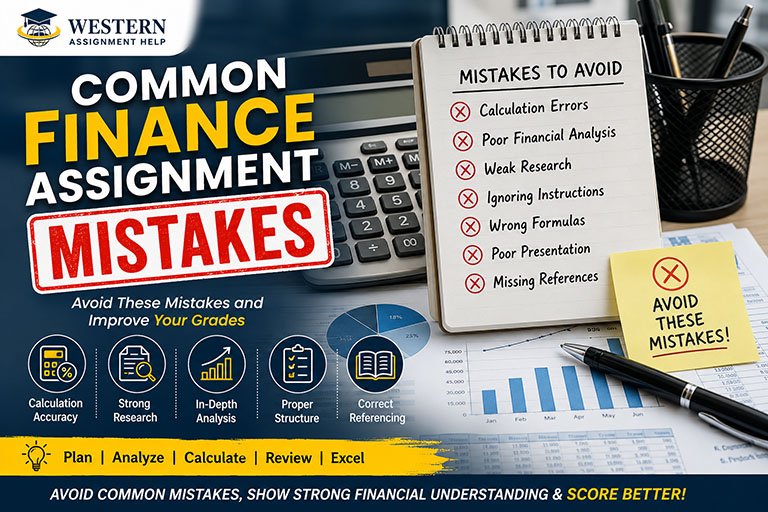
Common Finance Assignment Mistakes: Complete Guide for Finance Students
Finance assignments are designed to test a student’s understanding of financial concepts, analytical abilities, problem-solving skills, and practical application of financial theories. However, many students lose valuable marks because of avoidable mistakes rather than a lack of knowledge.
Whether you are studying corporate finance, financial management, investment analysis, accounting, or business finance, avoiding common assignment mistakes can significantly improve your academic performance.
Many finance assignments require accurate calculations, critical thinking, research skills, and professional presentation. A small mistake in financial analysis or interpretation can affect the overall quality of the assignment and lead to lower grades.
This guide explores the most common finance assignment mistakes and provides practical strategies to help students avoid them.
Why Students Make Finance Assignment Mistakes
Finance assignments are often more challenging than other academic subjects because they combine:
- Mathematics
- Accounting
- Economics
- Statistics
- Business Analysis
- Financial Decision-Making
Students frequently face pressure from deadlines, complex calculations, and multiple academic commitments, which increases the likelihood of errors.
Common Finance Assignment Mistakes: Misunderstanding Assignment Requirements
One of the biggest mistakes students make is starting an assignment without fully understanding what the instructor expects.
Many students:
- Misinterpret the question
- Ignore specific instructions
- Miss required calculations
- Fail to address key objectives
Before starting any assignment:
- Read the instructions carefully
- Identify the required finance concepts
- Understand grading criteria
- Clarify uncertainties with your instructor
A clear understanding of requirements helps prevent unnecessary mistakes.
Common Finance Assignment Mistakes: Weak Research
Finance assignments should be supported by credible and up-to-date information.
Students often make the mistake of relying on:
- Outdated sources
- Unverified websites
- Personal opinions
- Incomplete financial data
Reliable research sources include:
- Academic journals
- Annual reports
- Government publications
- Financial databases
- Industry reports
Strong research improves both the credibility and quality of finance assignments.
Students seeking support with research and assignment preparation can also explore our Finance Assignment Help service.
Common Finance Assignment Mistakes: Calculation Errors
Finance assignments often involve complex calculations such as:
- Net Present Value (NPV)
- Internal Rate of Return (IRR)
- Weighted Average Cost of Capital (WACC)
- Return on Investment (ROI)
- Financial Ratios
- Discounted Cash Flow (DCF)
Even minor calculation errors can significantly affect final results.
Students should:
- Double-check calculations
- Use formulas correctly
- Verify assumptions
- Review spreadsheet formulas
Accuracy is essential in finance because decisions are often based on numerical results.
Common Finance Assignment Mistakes: Poor Financial Analysis
Many students focus only on calculations and fail to explain what the results actually mean.
For example:
Calculating a Current Ratio of 2.5 is not enough.
Students should also explain:
- What the ratio indicates
- Whether the result is good or bad
- How it compares with industry standards
- Its impact on business performance
Strong analysis demonstrates critical thinking and deeper understanding.
Common Finance Assignment Mistakes: Ignoring Financial Ratios
Financial ratio analysis is one of the most important aspects of finance assignments.
Students often:
- Use incorrect formulas
- Misinterpret ratios
- Ignore ratio analysis completely
Important ratios include:
- Profitability Ratios
- Liquidity Ratios
- Solvency Ratios
- Efficiency Ratios
Students who want a deeper understanding of financial statement analysis can also review our Financial Ratio Analysis Guide.
Common Finance Assignment Mistakes: Weak Structure and Formatting
Even a well-researched assignment can lose marks if it is poorly organized.
Common formatting issues include:
- Missing headings
- Poor paragraph structure
- Inconsistent referencing
- Unclear tables and charts
- Lack of logical flow
A professional structure typically includes:
- Introduction
- Main Analysis
- Findings
- Recommendations
- Conclusion
- References
Well-structured assignments are easier to read and evaluate.
Common Finance Assignment Mistakes: Failing to Use Real-World Examples
Finance is a practical subject.
Students often make assignments too theoretical and fail to connect concepts with real business situations.
Including examples from:
- Public companies
- Financial markets
- Investment projects
- Business case studies
can significantly strengthen assignment quality.
Common Finance Assignment Mistakes: Poor Time Management
Many students start finance assignments too late.
This creates problems such as:
- Rushed calculations
- Weak research
- Poor editing
- Missed deadlines
Effective planning helps students complete assignments with greater accuracy and confidence.
Common Finance Assignment Mistakes: Ignoring Investment Analysis
Investment analysis is a core component of many finance assignments. However, students frequently overlook important factors when evaluating investment opportunities.
Common mistakes include:
- Ignoring risk factors
- Using unrealistic assumptions
- Misinterpreting financial data
- Failing to compare alternatives
- Overlooking market conditions
Students studying valuation and investment appraisal can strengthen their understanding by reviewing our Investment Analysis Assignment Tips guide.
Common Finance Assignment Mistakes: Incorrect Capital Budgeting Decisions
Capital budgeting assignments require careful analysis because businesses often use these techniques to make long-term investment decisions.
Students commonly:
- Apply the wrong discount rate
- Miscalculate NPV
- Misinterpret IRR results
- Ignore cash flow timing
- Forget to consider risk
Understanding capital budgeting concepts is essential for producing accurate finance assignments.
Students can also review our Capital Budgeting Explained guide for additional insights.
Practical Example
Consider a student completing a finance assignment on investment appraisal.
The student calculates a project’s Net Present Value (NPV) but forgets to discount future cash flows correctly.
Incorrect Approach
- Uses nominal cash flows
- Ignores the discount rate
- Assumes future cash is worth the same as current cash
Correct Approach
- Applies the appropriate discount rate
- Calculates present values accurately
- Considers the time value of money
This simple mistake can completely change the investment decision and significantly reduce assignment marks.
How to Avoid Common Finance Assignment Mistakes
Students can improve assignment quality by following these best practices:
Understand the Question
Read instructions carefully and identify key requirements.
Verify Calculations
Double-check formulas and numerical results.
Use Reliable Sources
Support analysis with credible academic and financial resources.
Interpret Results
Explain the significance of calculations rather than simply presenting numbers.
Include Real-World Examples
Use practical business examples to support financial arguments.
Proofread Before Submission
Review grammar, formatting, calculations, and references.
Additional Learning Resources
Students who want to improve their finance knowledge can explore educational resources from trusted organizations.
Investopedia provides beginner-friendly explanations of financial concepts, investment analysis, capital budgeting, and financial statement analysis.
Corporate Finance Institute (CFI) offers practical learning materials on financial modeling, valuation, corporate finance, and investment analysis.
CFA Institute provides professional-level educational resources covering investment management, financial analysis, ethics, and portfolio management.
Frequently Asked Questions
- What are the most common finance assignment mistakes?
The most common mistakes include calculation errors, weak research, poor financial analysis, incorrect formulas, poor formatting, and misunderstanding assignment requirements.
- Why do students lose marks in finance assignments?
Students often lose marks because they fail to explain financial results, use inaccurate calculations, or ignore assignment instructions.
- How can I improve my finance assignments?
Improve your assignments by conducting strong research, verifying calculations, analyzing results, and using real-world examples.
- Why is financial analysis important in assignments?
Financial analysis helps demonstrate critical thinking and shows that students understand the practical implications of financial data.
- What finance topics cause the most difficulties?
Students commonly struggle with NPV, IRR, financial ratios, capital budgeting, investment analysis, and business valuation.
- How can I avoid calculation errors?
Double-check formulas, review assumptions, use spreadsheet tools carefully, and verify numerical results before submission.
- Are real-world examples important in finance assignments?
Yes. Real-world examples strengthen arguments and demonstrate practical understanding of financial concepts.
Conclusion
Finance assignments require more than accurate calculations. Students must demonstrate research skills, analytical thinking, financial interpretation, and professional presentation.
Many students lose marks because of avoidable mistakes such as weak research, calculation errors, poor analysis, and ineffective time management.
By understanding and avoiding these common finance assignment mistakes, students can improve assignment quality, achieve better grades, and develop practical financial skills that are valuable in both academic and professional settings.