

Is Assignment Help Cheating in Australia? What University Policy Says
Is assignment help cheating in Australia? It’s one of the first questions many university students ask, usually right before a deadline closes in, a topic gets difficult, or juggling study with work and other responsibilities starts to feel like too much.
It really comes down to the type of help involved and your university’s academic integrity rules. Getting help to understand a concept, tidy up your grammar, or plan out an assignment isn’t automatically cheating, but asking someone else to complete an assessment for you and submitting it as your own can be treated as a serious breach. Knowing where that line sits makes it much easier to make smart choices, and that’s exactly what this guide covers: what Australian universities typically expect, which kinds of help are generally fine, and how to get support without compromising your academic honesty.
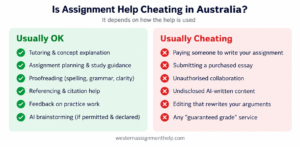
Is Assignment Help Cheating in Australia?
So, is assignment help cheating in Australia? Not automatically — it depends entirely on how that help gets used.
Australian universities expect students to complete their assessments honestly and in line with their institution’s academic integrity requirements — the Tertiary Education Quality and Standards Agency (TEQSA) frames academic integrity around honesty, trust, fairness, respect and responsibility, and most university policies echo that same framework, so students carry the responsibility of knowing their university’s rules and completing coursework the way their course actually requires. Think about the gap between asking a tutor to walk you through a confusing concept versus paying someone to write an entire essay that you then submit as your own: the first tends to support genuine learning, while the second can tip into contract cheating.
So using assignment help isn’t automatically a policy violation. What matters is the type of service used, how much assistance is involved, and what the specific assessment rules allow. Students weighing up assignment help in Australia are often better off checking their course guidelines first, before deciding what kind of support fits.
What Does Academic Integrity Mean in Australian Universities?
Academic integrity, at its core, is about being honest about your work and owning what you submit.
In day-to-day terms, students are generally expected to:
- Submit their own work whenever an assessment calls for individual effort.
- Acknowledge sources with correct referencing.
- Steer clear of plagiarism and unauthorised collaboration.
- Follow the assessment instructions as written.
- Only use outside assistance where it’s actually permitted.
- Avoid passing off someone else’s work as their own.
The Australian government’s higher education regulator, TEQSA, describes academic misconduct as any behaviour that breaches academic integrity, and its examples include plagiarism, collusion, contract cheating, recycling old work, and fabricating information. It’s worth noting that similar questions come up outside Australia too. Students weighing whether getting outside support counts as cheating in the UK face much the same considerations, which suggests these expectations are fairly consistent across university systems.
Every university sets its own academic integrity policy, assessment rules, and process for handling suspected misconduct, so students shouldn’t assume that something allowed in one course will automatically be fine in another — is assignment help cheating in Australia if you haven’t checked these principles for your own course? Not necessarily, but it does raise your risk if you skip that step, so if you’re ever unsure, check your university’s academic integrity policy or ask your lecturer before bringing in outside help.
What Types of Assignment Help Are Usually Acceptable?
Here’s where the question, “is assignment help cheating in Australia,” usually gets a reassuring answer. The following kinds of support tend to be useful for students and are often permitted, though it still depends on the assessment rules.
1. Tutoring and Concept Explanation
A tutor can help clear up a topic you’re struggling with.
Say a student studying accounting is stuck on financial ratios. A tutor could walk through the formulas, work through a similar example, and let the student practise on their own. That kind of support is about building understanding, not replacing the student’s own assessment work. Students who want ongoing guidance sometimes turn to a university assignment help service that focuses on explanation and skill-building rather than handing over finished answers.
That said, if your university rules out outside assistance for a particular task, that instruction still applies to you.
2. Assignment Planning and Study Guidance
Some students grasp the subject fine but struggle to get their ideas organised.
Academic support can help with things like:
- Understanding what the assignment question is actually asking.
- Breaking a big task down into smaller, manageable steps.
- Putting together a study plan.
- Explaining how an academic essay is typically structured.
- Talking through general research methods.
- Getting a handle on referencing basics.
Guidance like this can make an assignment feel a lot less overwhelming. The student is still the one developing their own arguments, doing the required research, and writing the work that gets submitted.
3. Grammar and Proofreading Support
Students who speak English as an additional language often want help sharpening the clarity of their writing, and basic proofreading — covering spelling mistakes, grammar issues, punctuation errors, and sentences that don’t quite land — is usually fine. There’s an important line, though, between proofreading and rewriting: if a service reshapes your work so heavily that it’s effectively supplying the ideas, arguments, or final answers, that’s no longer simple proofreading, and some universities also require students to disclose certain kinds of editing help. Always check the assessment instructions before submitting work that someone else has edited.
4. Referencing and Citation Guidance
Referencing can trip students up, especially while they’re still learning APA, Harvard, MLA, or another citation style.
A tutor might explain things like:
- How to cite a journal article correctly.
- How to format a reference list.
- When quotation marks are actually needed.
- How to avoid plagiarising by accident.
- How to separate your own ideas from a source’s ideas.
Picking this up early helps students build stronger academic writing habits over time. Even so, the student remains responsible for making sure the references in their final submission are accurate.
5. Feedback on Practice Work
Feedback is genuinely useful when you’re gearing up for future assessments.
A student might ask a tutor why a practice paragraph reads unclearly, or how an argument could be backed up better.
What matters here is whether feedback is allowed for that particular assessment. Some tasks permit it, while others expect fully independent work with no outside input at all.
What Types of Assignment Help Count as Cheating in Australia?
This is the other side of the question. Not every form of assignment help is safe to use, and some services create real academic integrity concerns.
1. Paying Someone to Write Your Assignment
This is about as clear-cut an example of misconduct as it gets: if a student pays another person or a commercial service to write an essay, report, or other assessment and then submits it under their own name, that can amount to contract cheating, which TEQSA defines as outsourcing an assessment to a third party — whether that’s a commercial provider, another student, a family member, or an acquaintance. The core issue isn’t just that money changed hands; it’s that the student ends up presenting someone else’s work as their own.
2. Submitting a Purchased Essay
Some websites sell pre-written essays, reports, and other academic assessments.
Submitting purchased work without permission breaches university academic integrity rules, plain and simple. It can also leave a student struggling to explain their own ideas if a lecturer asks follow-up questions about the submission.
Be especially wary of services promising guaranteed grades or offering to complete an entire assessment for you.
3. Unauthorised Collaboration
Working alongside classmates has real value, but it isn’t always allowed.
Some assignments call for strictly individual work. If students share answers, split up sections to write, or collaborate without approval, that can breach the assessment rules.
Check whether collaboration is permitted, and what form it’s allowed to take, before teaming up with classmates.
4. Using AI Without Checking the Rules
AI tools are increasingly common in education, but what’s permitted varies a lot between universities and even between individual assessments — some tasks allow AI for brainstorming or improving language, while others restrict or ban it outright, so don’t assume ChatGPT or a similar tool is automatically fine. Check the assessment instructions and your university’s policy, follow any disclosure requirements that apply, and most importantly, never submit AI-generated work as your own where the rules prohibit it.
What Are the Risks of Academic Integrity Breaches in Australia?
Students who breach academic integrity requirements can face consequences under their university’s policies.
The outcome usually depends on things like:
- The nature of the alleged breach.
- Which assessment was involved.
- The university’s academic integrity procedures.
- Whether the student has any prior misconduct findings.
- The evidence on hand.
- How the student responds to the allegation.
Consequences can range from a warning, to a reduced mark, to a zero on the assessment, or other disciplinary action. More serious cases can lead to further penalties under university rules.
Don’t assume every case plays out the same way. Universities each run their own procedures, so it’s worth reading the specific policy that applies to you.
Australia also has laws targeting commercial academic cheating services. It’s illegal to provide or advertise a commercial contract cheating service to students at an Australian higher education provider, with penalties that can include imprisonment and significant fines for the people running these services — one more reason to steer clear of businesses offering to complete assessments on a student’s behalf.
How Can Students Use Assignment Help Responsibly in Australia?
A few simple habits can help students avoid the risk of academic misconduct, whatever their answer to “is assignment help cheating in Australia” turns out to be for their own situation.
Read Your University Policy
Track down your university’s academic integrity policy, student handbook, and assessment instructions.
Pay close attention to rules covering:
- Individual and group work.
- Proofreading.
- AI tools.
- Tutoring.
- Referencing.
- External assistance.
- Assessment declarations.
If any of the wording is unclear, ask your lecturer or tutor to clarify it.
Ask for Learning Support, Not Completed Work
When you reach out for assignment help, be upfront that you want to understand the topic and build your skills, not hand over the whole task.
Instead of asking someone to write your essay for you, ask them to explain how to build a strong thesis statement or structure an argument. This keeps you learning while you stay responsible for your own assessment.
Keep Your Own Notes and Drafts
Hang onto your research notes, outlines, and drafts as you go.
These materials help you track how your work developed, and they can come in handy if your lecturer ever wants to talk through your process.
Check Before You Submit
Before you hit submit, make sure:
- You genuinely understand the content.
- The work follows the assessment instructions.
- Your references are accurate.
- Any required AI or editing disclosures are included.
- You haven’t submitted someone else’s work as your own.
If you’re unsure whether a particular type of help is allowed, check with your university before submitting.
What Should Students Look for in an Assignment Help Service?
Students searching for assignment help in Australia should weigh up whether a service genuinely supports learning or just replaces the student’s own work.
A responsible provider should be upfront about what it offers and shouldn’t push students toward breaking academic integrity rules.
Before picking a provider, ask:
- Does it explain concepts and offer real educational guidance?
- Does it lean toward tutoring and feedback rather than completing assessments outright?
- Is it transparent about its policies?
- Does it encourage students to follow university rules?
- Does it avoid promising guaranteed grades?
Students exploring assignment help in Australia can look at Western Assignment Help as one option for understanding assignment topics, sharpening study skills, and getting genuine academic support. Even so, students should always check their own university’s requirements and stay responsible for whatever they end up submitting.
Frequently Asked Questions About Assignment Help and Cheating in Australia
Q: Is using assignment help illegal in Australia?
A: Using academic support isn’t automatically illegal. That said, Australian law does prohibit providing or advertising commercial academic cheating services, so students should steer clear of any service offering to complete assessments for submission as their own.
Q: Is proofreading allowed at Australian universities?
A: Proofreading is often permitted, but the rules vary from one institution to the next. Some universities or assessments restrict editing or require it to be disclosed, so always check the relevant policy first.
Q: Is assignment help cheating in Australia for international students?
A: The same academic integrity expectations generally apply to international students at Australian universities. If you’re an international student weighing up your options, it’s worth reading up on assignment help for international students so you know exactly where the lines sit before asking for outside support.
Q: Does using a paid tutor count as cheating?
A: Not on its own. A tutor who explains concepts, reviews your understanding, or gives feedback is offering learning support. It only becomes an issue if the tutor starts writing or substantially completing your assessment for you.
Final Thoughts
So, is assignment help cheating in Australia? Not necessarily — it comes down to how the help gets used. Tutoring, concept explanation, study guidance, and permitted proofreading can all support genuine learning, while paying someone to complete an assessment and submitting it as your own can breach academic integrity rules. Always check your university’s policies before bringing in outside assistance, and when in doubt, lean toward support that helps you actually understand the subject and complete your own work. There’s nothing to be ashamed of in getting help with your studies — the real goal is to learn, build confidence, and get your university work done honestly.